Vapor Corrosion Inhibitors (VCI) and Moisture Control in Heavy Equipment Export Packaging
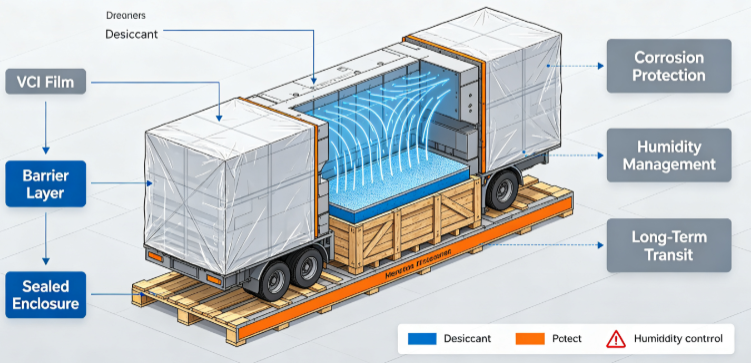
1. Introduction: The Two-Enemy Problem in Ocean Export
I have been specifying export packaging for heavy industrial equipment for over a decade, and I can tell you that the most expensive mistake in ocean freight protection is treating corrosion and moisture as the same problem.
They are not. Corrosion is an electrochemical reaction that requires three ingredients: metal, oxygen, and an electrolyte — typically water or moisture. Moisture is the physical liquid that condenses on cold metal surfaces during transit. You can have moisture without corrosion if the metal is protected by a corrosion inhibitor. And you can have corrosion without visible moisture if the relative humidity is high enough to support the electrochemical reaction.
VCI and desiccant address different parts of the problem. VCI neutralizes the corrosion reaction at the metal surface. Desiccant removes the moisture from the air that would otherwise condense on the equipment. If you deploy one without the other, you are leaving half of the problem unaddressed.
The global anti-corrosive packaging market continues to expand, driven by the growth of heavy machinery exports and the increasing sophistication of corrosion protection requirements. In the heavy machinery and mining sectors alone, the transition from oil-based protection to VCI film and paper systems remains incomplete — an estimated 40–50% of the potential replacement volume has not yet been converted . That gap represents both an opportunity for exporters who adopt the technology early and a risk for those who are still relying on grease and oil coatings.
This guide breaks down the VCI chemistry, the desiccant calculation method, the sealing requirements, and the sourcing framework that prevents the rusted shipment.
2. How VCI Chemistry Actually Protects Metal
VCI — Vapor Corrosion Inhibitor — is a class of chemical compounds that continuously emit protective molecules into the air inside a sealed package. The mechanism has four steps, and understanding them explains why VCI works in places that liquid coatings cannot reach.
Vaporization. The VCI compound is impregnated into a carrier material — film, paper, foam, or emitter — and vaporizes at ambient temperature. The VCI molecules have enough vapor pressure to leave the carrier, fill the enclosed space, and reach every exposed metal surface in the package .
Diffusion. The vaporized molecules travel through the internal atmosphere of the sealed package. Because they travel as a gas, they reach deep cavities, threaded holes, hydraulic ports, gear teeth, and internal channels that no liquid oil, grease, or paint can penetrate .
Adsorption. Once the VCI molecules contact a metal surface, they adsorb onto it and form a monomolecular barrier just 1–2 molecules thick. This barrier blocks the electrochemical reaction between metal, moisture, and oxygen — the three ingredients required for rust to form .
Self-replenishment. As long as the package remains sealed, VCI molecules continuously circulate. If the protective layer is disturbed or a new surface is exposed, the VCI vapor re-adsorbs and re-establishes the barrier. The protection is persistent and self-replenishing throughout the transit period .
The critical advantage of VCI over traditional oil and grease coatings is that the equipment arrives clean and ready to use. There is no degreasing step required before commissioning . For heavy machinery that may be installed in remote locations with limited cleaning facilities, this is a significant operational benefit.
The vapor-inhibiting ability of VCI materials is evaluated under NACE TM0208, the standard laboratory test method for temporary corrosion protection of ferrous metal surfaces. This test evaluates the combination of vapor transport across a gap and the actual corrosion protection delivered . When specifying VCI materials, the supplier should provide NACE TM0208 test data as evidence of performance.
3. The Moisture Problem: Container Rain and Why VCI Alone Is Not Enough
A steel shipping container on an ocean vessel is, in effect, a corrosion accelerator. During a typical 30-day sea voyage, the combination of extreme humidity — 90%+ relative humidity — salt-laden sea air, temperature cycling from 15°C to 60°C, and industrial pollutants at loading ports creates ideal conditions for rapid electrochemical corrosion .
The mechanism is called container rain. Extreme temperature fluctuations during international transit cause trapped humidity inside the shipping container to vaporize during the day and rapidly condense into liquid water on cold metal surfaces at night. The liquid water then drips from the ceiling and walls onto the cargo below .
Without protection, rust can begin forming on bare steel surfaces within 24 hours of container sealing. By the time the container arrives at its destination — often 30 to 60 days later — precision-machined surfaces such as spindles, ballscrews, bearing seats, and gear teeth can be irreparably damaged . The cost of corrosion damage frequently equals 30–50% of the machine's total value, with precision recalibration often impossible after severe pitting .
This is why VCI alone is not enough. VCI protects the metal surface from the corrosion reaction, but it does not remove the liquid water that condenses on the equipment. If the moisture load is high enough, the water can physically displace the VCI layer, and the corrosion protection is compromised. The solution is a coordinated system: VCI for the metal surface, a moisture barrier to seal the environment, and desiccant to absorb the trapped moisture.
Protection Layer | Function | Failure Mode If Missing |
Clean dry preparation | Remove existing moisture and contaminants | Residual moisture triggers flash rust |
VCI | Neutralize corrosion reaction at the metal surface | Surface corrosion begins within 24 hours |
Moisture barrier | Seal the internal environment from external humidity | Container rain condenses on equipment |
Desiccant | Absorb moisture trapped inside the sealed barrier | Condensation accumulates inside the package |
4. Desiccant Sizing: The DIN 55474 Calculation Method
The desiccant requirement for a sealed export package is not estimated. It is calculated. The standard method is DIN 55474, which determines the number of desiccant units required based on the moisture load from three distinct sources.
The desiccant unit definition. Under DIN 55473, one desiccant unit (DU) is the amount of desiccant that absorbs at least 6.0 g of water vapor at 23 ± 2°C and 40% relative humidity when in equilibrium with the surrounding air . At 20% RH, the same DU absorbs approximately 3 g. At 60% RH, it absorbs 8 g.
The calculation formula.
n = (1/a) × (V × b + m × c + A × e × WDD × t)
Where:
n = number of desiccant units required
a = water absorbed per desiccant unit at the target humidity (g). At 40% RH, a = 6 g.
V = internal volume of the sealed package (m³)
b = moisture content of the enclosed air at packing conditions (g/m³). At 20°C and 85% RH, b = 15 g/m³
m = weight of hygroscopic packaging materials (kg)
c = moisture content factor of the packaging materials (g/kg). For air-dried wood at 18% moisture content, c = 80. For wood and cardboard with undefined moisture content, c = 80 .
A = surface area of the barrier film (m²)
e = correction factor for the target humidity. At 40% RH, e = 0.7
WDD = water vapor transmission rate of the barrier film (g/m²/day). For LDPE film at 0.2mm thickness, WDD = 0.4. For aluminum composite film, WDD < 0.1 .
t = transport and storage time (days)
The three moisture sources. The formula accounts for the moisture in the enclosed air (V × b), the moisture in the hygroscopic packaging materials (m × c), and the moisture that diffuses through the barrier film during transit (A × e × WDD × t) .
Worked example. A sealed wooden crate for a CNC machine tool with the following conditions:
Internal volume (V): 4 m³
Packing conditions: 20°C, 85% RH → b = 15 g/m³
Hygroscopic materials (wood pallets, cardboard): m = 80 kg → c = 80
Barrier film area: A = 12 m²
Barrier type: Aluminum composite → WDD = 0.1
Transport time: t = 60 days
Target humidity: 40% RH → a = 6 g, e = 0.7
n = (1/6) × [(4 × 15) + (80 × 80) + (12 × 0.7 × 0.1 × 60)]
n = (1/6) × [60 + 6,400 + 50.4] ≈ 1,085 desiccant units
The hygroscopic packaging materials contribute 6,400 g of the total 6,510 g moisture load — over 98% of the total. The wooden pallets and cardboard are the dominant moisture source, not the enclosed air. This is why pre-drying the wooden components or specifying kiln-dried lumber with a defined moisture content can dramatically reduce the desiccant requirement.
Moisture Source | Formula Component | Example Value | % of Total |
Enclosed air | V × b | 60 g | 0.9% |
Hygroscopic packaging | m × c | 6,400 g | 98.3% |
Barrier diffusion | A × e × WDD × t | 50.4 g | 0.8% |
5. Sealing Integrity: Where Most VCI Systems Fail
The best VCI chemistry in the world will fail if the package is not sealed. VCI molecules are designed to vaporize and diffuse — which means they will escape through any opening in the barrier.
The barrier must be continuous. Every penetration point in the sealed barrier must be closed. The bolting holes that secure the machine to the crate base are the most common failure point. Cable pass-throughs, hydraulic line openings, and any gap in the film must be sealed with tape, mastic, or gaskets.
The barrier must be sealed before the desiccant is saturated. Desiccant begins absorbing moisture immediately upon exposure to air. If the desiccant is placed inside the package and the package is left open during packing, the desiccant will absorb ambient moisture rather than the trapped moisture inside the sealed environment.
VCI emitters and films must be positioned correctly. Industry guidelines recommend placing VCI emitters within approximately 300 mm of the metal surfaces they are intended to protect . For large equipment with internal cavities — gearboxes, electrical enclosures, hydraulic tanks — emitters should be placed inside the cavity, not just outside the equipment.
The sealing sequence matters. The correct sequence is: clean and dry the metal, apply the VCI, install the barrier, place the desiccant inside the barrier, seal the barrier, and verify the seal before the container doors close.
Sealing Failure Point | Consequence | Prevention |
Unsealed bolting holes | VCI escapes; moisture enters | Mastic or gasket at every penetration |
Barrier seam not heat-sealed | Continuous leak path | Heat-seal all seams |
Desiccant exposed before sealing | Desiccant saturated before use | Seal barrier immediately after desiccant placement |
Emitter too far from metal surface | Insufficient VCI concentration | Place emitters within 300 mm of surfaces |
Package opened during transit | VCI concentration lost | Seal and mark “Do Not Open” |
6. Head-to-Head: VCI Product Formats and Their Applications
Product Format | Construction | Protection Duration | Best Application | Moisture Barrier |
VCI Plain Paper | Kraft paper infused with VCI (55–65 GSM) | 6–12 months | Wrapping flat metal surfaces, machine beds, slideways | Low |
Poly-Coated VCI Paper | VCI paper + PE laminate (75–85 GSM) | 12–24 months | Moisture-prone environments | Moderate |
VCI Crepe Paper | Stretchable crinkled VCI paper (110–120 GSM) | 12–24 months | Complex geometries — spindles, bearings, gears, threaded parts | Low-Moderate |
VCI HD Reinforced Paper | VCI paper + scrim (135–180 GSM) | 24+ months | Heavy engineering, defense equipment | Moderate |
VCI Film (stretch/shrink) | PE film with VCI additives | 12–36 months | Enclosing entire machines, heat-sealed | High |
VCI Emitters | Foam or chipboard devices | 6–24 months | Internal cavities, electrical enclosures, void spaces | N/A |
Aluminum Barrier Film | 4-layer Al foil + VCI | 24+ months | Vacuum-sealed, hermetic enclosure for precision machinery | Complete |
7. Case Study: 27 Lube Oil Skids — 12 Months in the Arabian Gulf
The most instructive documented case study for VCI and moisture control in heavy equipment preservation comes from Cortec Corporation's work with a manufacturer of mechanical fluid systems.
The situation. A customer requested a solution for the internal and external preservation of 27 lube oil skids and rundown tanks. The equipment was to be stored outdoors for 12 months in the Arabian Gulf environment while waiting for the completion of an oil and gas construction project. The preservation system had to comply with GE specifications, providing continuous protection against air and moisture in an aggressive atmosphere.
The solution. The preservation process had four layers. Tank internals were fogged with VpCI-329, a vapor-phase corrosion inhibitor. Junction boxes were internally protected with VpCI-101 devices. Larger enclosed volumes were equipped with VpCI-132 foam pads. Sharp edges were padded with foam before VpCI-126 HP UV shrink film was wrapped and heat-shrunk around the equipment. Netting was added for extra mechanical protection on some of the skids.
The result. At the end of 12 months, the equipment was inspected and found to be in good condition, satisfying the customer's requirements with a simple, dependable solution for a challenging environment.
The complementary case. A mining equipment company with a location in Chile found components that were already showing signs of corrosion after one year of storage inside vacuum-sealed packages — without VCI. The company needed to store the components corrosion-free for one more year and decided to repackage the equipment in VpCI-126 HP UV Shrink Film with VpCI-111 Emitters inside the voids . The case demonstrates that vacuum sealing alone does not prevent corrosion. Without VCI, even a sealed package can develop corrosion if residual moisture is present.
The lesson for B2B buyers. The packaging system worked because it addressed each failure mechanism with a specific layer: VCI fogging for internal surfaces, foam pads for larger enclosed volumes, shrink film for the moisture barrier, and netting for mechanical protection. No single layer would have been sufficient. The system succeeded because it was designed as a system.
8. Cost Analysis: VCI System vs. Oil-Based Protection
The cost comparison between VCI and traditional oil-based protection is not just about the material cost. It is about the total cost of the protection process, including application labor, removal labor, waste disposal, and the risk of corrosion failure.
Cost Factor | Oil/Grease Coating | VCI System |
Material cost | Low | Moderate |
Application labor | High — manual coating of all surfaces | Low — wrap, emit, seal |
Coverage completeness | Incomplete — internal cavities may be missed | Complete — vapor reaches all surfaces |
Removal before use | Required — degreasing, solvent, labor | Not required — equipment arrives clean |
Waste disposal | Solvent and grease disposal costs | Minimal — film and paper recyclable |
Protection duration | 3–6 months typical | 12–36 months |
Risk of corrosion failure | Higher — coating can be damaged or missed | Lower — self-replenishing VCI layer |
Total cost per equipment unit | Higher when removal labor is included | Lower over the full preservation cycle |
The cost of failure. A machine that arrives rusted requires remediation: disassembly, cleaning, rust removal, repainting, reassembly, recalibration, and re-testing. The cost can easily exceed the entire packaging budget. And that is before accounting for the project delay and the customer relationship damage.
The IndexBox report notes that the transition from oil-based to VCI film/paper systems in the heavy machinery and mining sectors remains incomplete, with only 40–50% of potential replacement volume converted . The primary barrier is not technical — it is the perception that oil coatings are cheaper. When the removal labor and disposal costs are included, the VCI system is often the lower-cost solution over the full preservation cycle.
9. Practical Sourcing Framework for B2B Buyers
If you are specifying VCI and moisture control for heavy equipment export packaging, here is the framework I recommend.
Step 1: Assess the equipment's moisture sensitivity. Different components have different corrosion thresholds. Bare steel surfaces begin to corrode at approximately 40% relative humidity. Electrical windings and precision ground surfaces are more sensitive. The moisture sensitivity determines the target internal humidity and the desiccant requirement.
Step 2: Calculate the desiccant requirement using DIN 55474. Do not estimate. The dominant moisture source is almost always the hygroscopic packaging materials — wooden pallets, cardboard, and dunnage. Use the formula n = (1/a) × (V × b + m × c + A × e × WDD × t) and require the supplier to provide a calculation worksheet for the specific shipment.
Step 3: Specify the VCI product format based on the equipment geometry. VCI paper for wrapping flat surfaces and individual parts. VCI film for enclosing large assemblies and creating sealed environments. VCI emitters for internal cavities, electrical enclosures, and void spaces that film cannot reach. Aluminum barrier film for the most demanding applications where hermetic sealing is required.
Step 4: Specify the barrier film and sealing method. For critical applications, specify aluminum composite barrier film with WDD < 0.1 g/m²/day. For standard applications, LDPE film at 0.2mm thickness (WDD = 0.4) is adequate. Require heat-sealing of all seams and sealing of all penetration points.
Step 5: Require NACE TM0208 test data for the VCI material. The vapor-inhibiting ability of the VCI material should be verified against the NACE TM0208 standard. Do not accept a generic “VCI film” specification without test evidence.
Step 6: Verify the sealing and desiccant placement procedure. Require the packaging supplier to provide a documented procedure for the sealing sequence: clean and dry, apply VCI, install barrier, place desiccant, seal barrier, verify seal. Include photos of the sealed package in the shipment documentation.
Sourcing Parameter | Specification | Verification |
VCI product format | Paper, film, emitter, or barrier foil | Supplier specification |
VCI test standard | NACE TM0208 | Test report |
Barrier film type | Al composite (WDD < 0.1) or LDPE (WDD = 0.4) | Supplier specification |
Desiccant calculation | DIN 55474 | Calculation worksheet |
Desiccant target humidity | < 40% RH | Calculation target |
Sealing method | Heat-seal for film; mastic for penetrations | Procedure documentation |
Protection duration | 12–24 months for ocean export | Supplier data |
10. Frequently Asked Questions
Q: What is VCI and how does it protect metal during export?
VCI (Vapor Corrosion Inhibitor) is a class of chemical compounds that vaporize from a carrier material into the air inside a sealed package. The molecules diffuse throughout the package and adsorb onto metal surfaces, forming a monomolecular barrier that blocks the electrochemical reaction between metal, moisture, and oxygen. The protection is self-replenishing as long as the package remains sealed.
Q: Can I use VCI without a moisture barrier?
VCI alone provides corrosion protection at the metal surface, but it does not remove liquid moisture from the package. In high-humidity ocean transit, container rain can condense on the equipment and physically displace the VCI layer. For any ocean transit exceeding two weeks, VCI should be combined with a moisture barrier and desiccant.
Q: How much desiccant do I need for a heavy equipment export package?
The desiccant requirement is calculated using the DIN 55474 formula, which accounts for the internal volume, the weight of hygroscopic packaging materials, the barrier film type, the voyage duration, and the target humidity. The dominant moisture source is almost always the wooden pallets and cardboard packaging. One desiccant unit (DIN 55473) absorbs at least 6.0 g of water vapor at 23°C and 40% RH.
Q: How long does VCI protection last?
VCI protection duration depends on the product format and the sealing integrity. VCI paper typically provides 6–12 months of protection. VCI film and emitters provide 12–36 months depending on the formulation and the storage conditions. Aluminum barrier film systems can provide protection for 24 months or longer. The protection period begins when the package is sealed and ends when the package is opened.
Q: What is the NACE TM0208 standard?
NACE TM0208 is the standard laboratory test method for evaluating the vapor-inhibiting ability (VIA) of VCI materials for temporary corrosion protection of ferrous metal surfaces. The test evaluates the combination of vapor transport across a gap containing air, water vapor, and VCI, and the actual corrosion protection delivered. VCI suppliers should provide NACE TM0208 test data.
Q: What is container rain and how do I prevent it?
Container rain is condensation that forms inside a shipping container when temperature and humidity conditions change during transit. Moisture condenses on the roof and side walls of the container and then drips down onto the cargo. Prevention requires a coordinated system: clean dry cargo, container desiccants to lower the dew point, and a sealed moisture barrier around the equipment.
Q: Can I use VCI on equipment that has internal cavities?
Yes. VCI emitters are specifically designed for internal cavities — gearboxes, electrical enclosures, hydraulic tanks, and void spaces that film or paper cannot reach. Emitters should be placed inside the cavity, not outside the equipment. Industry guidelines recommend placing emitters within approximately 300 mm of the metal surfaces they are intended to protect.
Q: How do I verify that the VCI system is working?
The supplier should provide NACE TM0208 test data for the VCI material. For the packaging procedure, require documentation of the sealing sequence and photos of the sealed package. For critical shipments, a humidity indicator card can be placed inside the sealed barrier to verify that the internal humidity remained below the target threshold throughout the voyage.
11. Final Thoughts
Let me leave you with this.
VCI and moisture control are not competing solutions. They are complementary layers of the same protection system. VCI neutralizes the corrosion reaction at the metal surface. Desiccant removes the moisture that would otherwise condense on the equipment. The barrier film seals the environment and keeps the system working. And the DIN 55474 calculation determines how much desiccant is required — based on the actual moisture load, not a guess.
The data is clear. Corrosion during ocean freight is the single largest cause of preventable damage to exported industrial machinery. Without protection, rust can begin forming within 24 hours of container sealing. The cost of corrosion damage equals 30–50% of the machine's value. And the Cortec case study demonstrates that a properly designed VCI system can protect 27 lube oil skids for 12 months in the Arabian Gulf environment.
Ready to Transform Your Packaging?
联系我们获取定制报价,我们的专业团队将为您设计最佳的包装解决方案