How to Choose the Right Export Packaging Solution for Heavy Industrial Equipment
1. Introduction: The Shipment That Arrived Rusted
I have been sourcing export packaging solutions for heavy industrial equipment for over a decade, and I can tell you that the most expensive packaging decision is the one that treats the shipping container as a box rather than a system.
Here is what that looks like in practice. A manufacturer ships a CNC machining center to a customer in Southeast Asia. The machine is bolted to a timber skid, wrapped in plastic sheeting, and loaded into a 40-foot container. The packaging looks solid. The documentation is complete. Twenty-eight days later, the container arrives at the destination port. When the doors are opened, the machine is covered in condensation. The bright slideways have bloomed with surface rust. The control cabinet has moisture inside. The customer rejects the shipment, and the manufacturer faces a repair bill, a delayed project, and a damaged relationship.
The problem was not the timber skid. It was not the plastic wrap. The problem was that the packaging system did not account for the three forces that define every ocean export: corrosion chemistry, mechanical shock, and trade compliance. The plastic wrap trapped moisture against the machine. The skid was not designed for the dynamic loads of ship motion. And nobody checked whether the timber was ISPM 15 compliant.
The global heavy-duty industrial bulk packaging market was valued at USD 28.8 billion in 2025 and is projected to reach USD 46.2 billion by 2035, growing at a CAGR of 4.8%. That growth is driven by the expansion of heavy machinery exports and the increasing complexity of international shipping regulations. For B2B buyers, the packaging decision is not a procurement formality. It is the difference between a machine that arrives ready to install and one that arrives requiring weeks of remediation.
This guide breaks down the export packaging decision — from equipment assessment through transport mode selection, moisture protection, structural design, ISPM 15 compliance, and the sourcing framework that prevents the rusted shipment.
2. Start with the Equipment, Not the Packaging
The first mistake in export packaging is choosing the packaging before understanding the equipment. A mining drill and an MRI machine have completely different fragility profiles, handling risks, and compliance requirements. The packaging must be designed around the equipment, not selected from a catalog.
Assess the weight and centre of gravity. Individual components of heavy industrial equipment can run from hundreds to tens of thousands of kilograms. The weight determines the skid design, the lifting points, and the transport mode. The centre of gravity determines the blocking and bracing strategy. A machine with a high centre of gravity — like an imaging system or a tall press — requires different restraint than a low, wide machine tool.
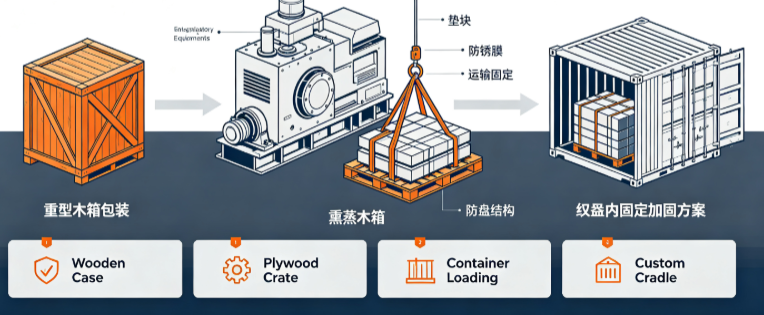
Assess the geometry. Heavy industrial equipment is often highly irregular in shape. Drill components, pump assemblies, conveyor sections, and hydraulic systems do not come in neat rectangular packages. Flanges, protrusions, and attachment points require purpose-built blocking. An open-frame timber crate protects protruding components while keeping the pack open to port inspection. For components with sensitive seals or precision-machined surfaces, an enclosed plywood case with internal foam blocking provides an additional layer of protection.
Assess the sensitivity. Different equipment fails for different reasons. Vibration-sensitive equipment — medical imaging systems, precision instruments — requires isolation from road and sea vibration. Static-sensitive equipment — electronics, control systems — requires anti-static protection. Moisture-sensitive equipment — anything with bare metal surfaces, electrical windings, or precision ground surfaces — requires barrier protection and desiccant. The sensitivity assessment determines which protection layers are mandatory and which are optional.
Assess the disassembly potential. Partial disassembly often reduces packaging cost and shipping cost. A machine that fits into a standard container after removing the control cabinet and the work table may cost far less to ship than one that requires a flat rack or break-bulk vessel. The question is whether the reassembly cost at the destination is lower than the shipping cost difference.
Equipment Assessment Parameter | What It Determines | Why It Matters |
Weight and centre of gravity | Skid design, lifting points, transport mode | Prevents structural failure and handling accidents |
Geometry and protrusions | Crate type (open frame vs. enclosed) | Protects irregular shapes from impact |
Vibration sensitivity | Isolation and cushioning requirements | Prevents calibration drift and component damage |
Moisture sensitivity | Barrier and desiccant requirements | Prevents corrosion during ocean transit |
Disassembly potential | Transport mode and packaging size | Can reduce total landed cost |
3. Matching Transport Mode to Packaging Design
The transport mode determines the packaging envelope — the maximum dimensions, the loading method, and the handling environment.
FCL (Full Container Load) is the workhorse for machinery that fits within standard container dimensions after partial disassembly. A 20-foot container holds roughly 28 CBM (up to 28 tons), while a 40-foot high-cube handles 68 CBM (up to 26 tons). The cargo is sealed at the factory and untouched until arrival — minimal handling means minimal damage risk. Transit runs 25–40 days on major lanes, and per-unit costs are the lowest among all methods for shipments exceeding 15 CBM.
Flat Rack and Open Top Containers handle machinery that is too wide or too tall for standard containers. A 40-foot flat rack supports up to 40 tons. The open-top design allows loading from above. Flat rack cargo requires steel strapping or chains to secure it to the container floor, and the packaging must be designed for the exposed environment — rain, salt spray, and wind loading during transit.
Break-Bulk Shipping is the option of last resort for cargo that is simply too large for any container. Break-bulk costs run $90–$180 per ton with transit times of 30–50 days. The cargo is lifted piece by piece into the vessel's hold or onto deck. Break-bulk is typically the most expensive per unit, but it is the only feasible option for very large project cargo. The packaging for break-bulk must be designed for the most demanding handling environment: multiple crane lifts, exposure to weather, and extended port storage.
Transport Mode | Max Dimensions | Typical Cost | Transit Time | Packaging Envelope |
FCL (20ft) | 5.9 × 2.35 × 2.39 m | Lowest per CBM | 25–40 days | Standard crate or skid |
FCL (40ft HC) | 12.0 × 2.35 × 2.69 m | Low per CBM | 25–40 days | Standard crate or skid |
Flat Rack (40ft) | 12.0 × 2.44 m (open top) | Medium + OOG surcharge | 30–45 days | Weather-resistant crate |
Break-Bulk | Unlimited | $90–$180/ton | 30–50 days | Heavy-duty weatherproof crate |
4. The Moisture Problem: Container Rain and Corrosion
Corrosion is the quiet destroyer of heavy equipment in ocean transit. A closed container on a multi-week tropical sailing cycles through day and night temperature swings. Container walls cool; moist air condenses; free water appears on steel, aluminium, and coated assemblies. That is container rain — and it is the primary cause of rust damage on machinery shipments.
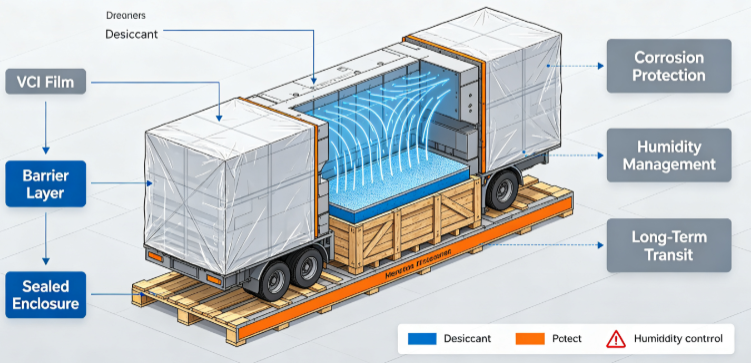
The defence is not a thicker crate. It is a coordinated system with four components.
Clean, dry metal preparation. The machine surface must be clean and dry before packaging. Any residual moisture, fingerprints, or process fluids become corrosion initiation sites.
Vapor Corrosion Inhibitor (VCI). VCI compounds vaporize and adsorb onto metal surfaces, forming a molecular barrier that prevents oxygen and moisture from contacting the metal. VCI is applied through films, emitters, foam pads, or fogging. VpCI-132 foam pads, for example, contain 10 times more VCI chemical per square meter than other wrapping materials, making them effective for large surfaces like export crates and seagoing containers.
Moisture barrier. A sealed barrier layer — typically an aluminium composite film or heavy-duty polyethylene — creates a closed environment around the machine. The barrier prevents the exchange of moisture between the inside and the outside. The barrier must be sealed at all penetration points: bolting holes, cable pass-throughs, and any opening in the film.
Sized desiccant. Desiccant absorbs the moisture that is trapped inside the barrier when it is sealed. The amount of desiccant is calculated based on the internal volume, the weight of hygroscopic packaging materials, the barrier type, and the voyage duration. DIN 55473 covers desiccant-bag delivery conditions, and the DIN 55474 formula provides the calculation method. Each desiccant unit absorbs up to 300% of its own weight in moisture, maintaining internal humidity below 40% RH — well below the corrosion threshold.
The sequence matters. VCI is applied first, then the barrier is sealed around the equipment, then the desiccant is placed inside the sealed barrier. If the barrier is not sealed, the desiccant will absorb moisture from the entire container rather than just the internal volume — and it will be exhausted long before the voyage ends.
Protection Layer | Function | Typical Specification |
Clean dry preparation | Remove moisture and contaminants | Surface dry, free of fingerprints and process fluids |
VCI | Vapor-phase corrosion inhibition | VCI film, foam pad, or fogging |
Moisture barrier | Seal the internal environment | Aluminium composite film, sealed at all penetrations |
Desiccant | Absorb trapped moisture | Sized per DIN 55474, <40% RH target |
5. Structural Protection: Blocking, Bracing, and Load Paths
The structural packaging — the skid, the crate, and the bracing — must survive the dynamic loads of ship motion, terminal handling, and road transport. Ship roll, pitch, slam, and terminal handling apply repeated dynamic loads. Unlocked CNC axes travel and crash. Unbraced press rams shift. Transformer bushings take side load. A pack that wraps the machine without immobilizing it is a pack that will arrive damaged.
Skid design. The skid is the foundation. It must distribute the machine's weight across the container floor or the vessel deck, and it must provide forklift access from at least two sides. The skid members are sized based on the machine's mass, centre of gravity, and load paths. For very heavy equipment, the skid may be fabricated from steel rather than timber.
Blocking and bracing. Blocking prevents movement in the longitudinal direction. Bracing prevents movement in the lateral and vertical directions. The bracing must be designed to resist the dynamic loads of ship motion — typically calculated as a percentage of the machine's weight, applied at the centre of gravity. Timber bracing, steel strapping, and chain binders are the standard methods.
Immobilization of moving parts. Locking the CNC axes, securing the press ram, and blocking the rotor are critical. A machine that moves internally during transit can damage itself far more severely than external impact.
Lifting and handling points. The crate must have clearly marked lifting points, centre-of-gravity markings, and handling instructions. These markings are required for safe handling and for customs inspection. Standard markings include “Centre of Gravity,” “Lifting Point,” “This Way Up,” and the gross weight.
6. ISPM 15 Compliance: The Non-Negotiable Requirement
Any solid wood packaging material that crosses an international border must comply with ISPM 15 — the International Standards for Phytosanitary Measures No. 15. The purpose is to prevent the spread of invasive pests through wood packaging.
The treatment requirement. Solid wood packaging must be heat-treated to a minimum core temperature of 56°C for at least 30 minutes, or fumigated with methyl bromide, or treated by dielectric heating. The treated wood must be debarked and marked with the IPPC stamp — the official mark that certifies compliance.
The marking requirement. The IPPC stamp must include the IPPC logo, the two-letter ISO country code, the treatment-provider ID number, and the treatment code (HT for heat treatment, MB for methyl bromide). As of January 1, 2026, the stamp must include a hyphen between the country code and the facility number (e.g., XX-00000). Non-compliant wood packaging faces rejection, destruction, or mandatory re-treatment at the destination port.
The practical compliance considerations. Many mining equipment export destinations — including Indonesia, the Philippines, Papua New Guinea, and African markets — have strict ISPM 15 enforcement at the port of entry. Non-compliant timber packaging is treated or destroyed on the spot. Use certified timber, every time, without exception.
Plywood, particle board, and other processed wood products are exempt from ISPM 15 because they are manufactured at high temperature and pressure, which kills pests. However, if the plywood is used as a component of a crate that also contains solid wood — such as a solid wood skid — the solid wood component must be compliant.
ISPM 15 Parameter | Requirement | Verification |
Heat treatment | Core temperature ≥56°C for ≥30 min | Treatment certificate |
Fumigation | Methyl bromide per ISPM 15 standard | Fumigation certificate |
Debarking | All solid wood must be debarked | Visual inspection |
IPPC stamp | Logo, country code, provider ID, treatment code | Visual inspection of stamp |
Hyphen requirement (2026) | XX-00000 format | Visual inspection |
Plywood exemption | Processed wood products are exempt | Supplier certification |
7. Head-to-Head: Export Packaging Systems Compared
Protection Level | Typical Construction | Corrosion Protection | Structural Protection | Relative Cost | Best For |
Basic | Timber skid + plastic wrap | None | Minimal | Lowest | Domestic transport, short transit |
Standard export | ISPM 15 skid + open-frame crate + VCI wrap | VCI + plastic wrap | Blocking + bracing | Medium | Standard machinery, 30-day ocean transit |
Seaworthy | ISPM 15 skid + enclosed plywood case + VCI + barrier + desiccant | Full system (VCI + barrier + desiccant) | Full blocking + bracing + immobilization | High | Precision machinery, multi-week ocean transit |
Heavy-lift | Steel skid + heavy-duty crate + full moisture system | Full system + container desiccant | Engineered load paths + steel bracing | Highest | Break-bulk, over-dimensional cargo |
8. Cost Analysis: What You Actually Pay
The cost of export packaging is not the cost of the crate. It is the total cost of the packaging system, the transport mode, the compliance documentation, and the risk of failure.
Crating cost. Standard machinery crating for domestic transport ranges from $300–$800 per crate. Export crating with ISPM 15 compliance ranges from $500–$1,200 for standard machinery, and $700–$2,500+ for heavy-duty export crates depending on the route and the protection system.
Moisture protection cost. VCI film, barrier film, and desiccant add $50–$300 depending on the machine size and the protection level. The cost of the moisture system is a fraction of the cost of repairing a rusted machine.
ISPM 15 treatment cost. Heat treatment adds approximately $3–$7 per pallet or crate depending on the supplier and volume. The cost is negligible compared to the cost of a rejected shipment.
Transport cost. FCL shipping from China to Europe or North America runs $2,500–$5,000 per container. Break-bulk shipping runs $90–$180 per ton plus port handling and stevedoring charges.
The cost of failure. A machine that arrives rusted requires remediation: disassembly, cleaning, rust removal, repainting, reassembly, recalibration, and re-testing. The cost can easily exceed the entire packaging budget. And that is before accounting for the project delay and the customer relationship damage.
Cost Category | Basic Packaging | Standard Export | Seaworthy Packaging |
Skid / base | $200–$500 | $300–$800 | $500–$1,500 |
Crate / case | $300–$600 | $500–$1,200 | $1,200–$2,500+ |
Moisture system | $0 | $50–$150 | $150–$500 |
ISPM 15 treatment | $0 | $3–$7 per crate | $3–$7 per crate |
Transport | $2,500–$5,000 (FCL) | $2,500–$5,000 (FCL) | $5,000–$15,000 (break-bulk) |
Failure risk | High | Moderate | Low |
9. Case Study: Preserving 27 Lube Oil Skids for 12 Months in the Arabian Gulf
The most instructive documented case study for heavy equipment export packaging comes from Cortec Corporation's work with a manufacturer of mechanical fluid systems.
The situation. A customer requested a solution for the internal and external preservation of 27 lube oil skids and rundown tanks. The equipment was to be stored outdoors for 12 months in the Arabian Gulf environment while waiting for the completion of an oil and gas construction project. The preservation system had to comply with GE specifications, providing continuous protection against air and moisture in an aggressive atmosphere.
The solution. The preservation process had four layers. Tank internals were fogged with VpCI-329, a vapor-phase corrosion inhibitor. Junction boxes were internally protected with VpCI-101 devices. Larger enclosed volumes were equipped with VpCI-132 foam pads. Sharp edges were padded with foam before VpCI-126 HP UV shrink film was wrapped and heat-shrunk around the equipment. Netting was added for extra mechanical protection on some of the skids.
The result. At the end of 12 months, the equipment was inspected and found to be in good condition, satisfying the customer's requirements with a simple, dependable solution for a challenging environment.
The lesson for B2B buyers. The packaging system worked because it addressed each failure mechanism with a specific layer. The VCI fogging protected the internal surfaces. The foam pads provided continuous protection for the larger enclosed volumes. The shrink film provided the moisture barrier. And the netting provided the mechanical protection. No single layer would have been sufficient. The system succeeded because it was designed as a system.
10. Practical Sourcing Framework for B2B Buyers
If you are specifying export packaging for heavy industrial equipment, here is the framework I recommend.
Step 1: Assess the equipment before selecting the packaging. Document the weight, centre of gravity, dimensions, protrusions, vibration sensitivity, moisture sensitivity, and disassembly potential. The packaging system must be designed around the equipment, not selected from a catalog.
Step 2: Match the transport mode to the packaging envelope. FCL is the workhorse for containerizable cargo. Flat rack handles oversized cargo with weather exposure. Break-bulk handles project cargo with the most demanding handling environment. The transport mode determines the packaging specification.
Step 3: Specify the moisture protection system as a complete unit. VCI + barrier + desiccant + clean dry preparation. Do not specify one layer without the others. The system is only as strong as its weakest layer.
Step 4: Require a desiccant calculation. For sealed barrier systems, require the supplier to provide a desiccant calculation per DIN 55474, based on the internal volume, barrier type, packaging materials, and voyage duration. Do not accept a generic “desiccant included” specification.
Step 5: Specify ISPM 15 compliance and the IPPC mark. Confirm that all solid wood components are heat-treated, debarked, and stamped with the IPPC mark including the hyphen between country code and facility number. Require the treatment certificate for each production lot.
Step 6: Specify the blocking and bracing design. For CNC machines, presses, transformers, and any equipment with moving parts, require a bracing design that immobilizes all moving components for ship motion. Request the bracing calculation or the design drawing.
Step 7: Require handling markings and documentation. Specify “Centre of Gravity,” “Lifting Point,” “This Way Up,” and gross weight markings on all four sides of the crate. Require the packing list, the treatment certificate, and the preservation record to be included in the documentation package.
Sourcing Parameter | Specification | Verification |
Skid design | Engineered for mass, CoG, and load paths | Design drawing or calculation |
Crate type | Open frame, enclosed plywood, or steel | Photo documentation |
Moisture system | VCI + barrier + desiccant | System specification and desiccant calculation |
ISPM 15 compliance | Heat-treated, debarked, IPPC stamped | Treatment certificate |
Blocking and bracing | Immobilizes all moving parts | Bracing design drawing |
Handling markings | CoG, lifting points, orientation, weight | Photo documentation |
Documentation | Packing list, treatment certificate, preservation record | Document review |
11. Frequently Asked Questions
Q: What is the most important factor in heavy equipment export packaging?
The most important factor is the moisture protection system. Container rain — condensation that forms on the inside of the container during temperature cycling — is the primary cause of rust damage on machinery shipments. A properly designed system of VCI, moisture barrier, and desiccant is essential for any ocean transit exceeding two weeks.
Q: How much does export packaging for heavy equipment cost?
Standard export crating with ISPM 15 compliance ranges from $500–$1,200 for standard machinery. Heavy-duty export crates for large equipment range from $700–$2,500+. The total packaging cost depends on the equipment size, the transport mode, the moisture protection level, and the compliance requirements.
Q: Do I need ISPM 15 certification for all wood packaging?
Yes. Any solid wood packaging material — crates, pallets, skids, dunnage — that crosses an international border must comply with ISPM 15. The wood must be heat-treated or fumigated, debarked, and marked with the IPPC stamp. Plywood and other processed wood products are exempt.
Q: What is the IPPC stamp and what does it include?
The IPPC stamp is the official mark that certifies ISPM 15 compliance. It includes the IPPC logo, the two-letter ISO country code, the treatment-provider ID number, and the treatment code (HT for heat treatment, MB for methyl bromide). As of January 1, 2026, the stamp must include a hyphen between the country code and the facility number.
Q: How do I calculate the right amount of desiccant?
The desiccant calculation per DIN 55474 accounts for the internal volume, the weight of hygroscopic packaging materials, the barrier film type, the voyage duration, and the target relative humidity. The target for machinery is to maintain internal humidity below 40% RH, which is the threshold for corrosion on steel surfaces.
Q: What is the difference between VCI and desiccant?
VCI (Vapor Corrosion Inhibitor) vaporizes and adsorbs onto metal surfaces, forming a molecular barrier that prevents corrosion. Desiccant absorbs moisture from the air inside the sealed package. Both are needed: VCI protects the metal surfaces, and desiccant controls the humidity. Neither is a substitute for the other.
Q: How do I choose between FCL, flat rack, and break-bulk shipping?
FCL is the best choice for machinery that fits within standard container dimensions after partial disassembly. Flat rack is for cargo that is too wide or too tall for a standard container. Break-bulk is for cargo that is too large for any container and must be lifted piece by piece onto the vessel. The choice depends on the equipment dimensions and weight.
Q: What documentation should accompany a heavy equipment export shipment?
The documentation package should include the packing list, the ISPM 15 treatment certificate, the commercial invoice, the bill of lading, the certificate of origin, and any required conformity certificates (CE, UL, etc.) for the destination market. The preservation record — documenting the VCI application, the barrier sealing, and the desiccant placement — should also be included for high-value shipments.
12. Final Thoughts
Let me leave you with this.
Heavy equipment export packaging is not a crate. It is a system. The system has four layers: clean dry preparation, vapor corrosion inhibition, moisture barrier, and sized desiccant for the moisture side. It has skid design, blocking, bracing, and immobilization for the structural side. It has ISPM 15 heat treatment, debarking, and IPPC marking for the compliance side. And it has handling markings, documentation, and loading instructions for the logistics side.
The data is clear. The heavy-duty industrial bulk packaging market is growing at 4.8% CAGR. Container rain is the primary cause of rust damage on machinery shipments. ISPM 15 enforcement is tightening at ports worldwide. And the Cortec case study demonstrates that a properly designed preservation system can protect equipment for 12 months in the Arabian Gulf environment.
Ready to Transform Your Packaging?
联系我们获取定制报价,我们的专业团队将为您设计最佳的包装解决方案