How to Choose a Heavy Equipment Export Packaging Solution
Table of Contents
· What the solution must achieve
· 1. Start with cargo and route data
· 2. Build the packaging architecture
· 3. Control moisture, shock and handling risk
· 4. Plan loading, labels and export documents
· 5. Compare suppliers and approve the pack
· Illustrative planning scenario
A heavy equipment export packaging solution protects a valuable machine through lifting, road movement, ocean or air transit, storage and final unpacking. The right answer is not simply a larger wooden box. It combines a stable base, controlled blocking, bracing, moisture protection, clear handling information and a loading plan that fits the transport route.
What the solution must achieve
A heavy equipment export packaging solution protects a valuable machine through lifting, road movement, ocean or air transit, storage and final unpacking. The right answer is not simply a larger wooden box. It combines a stable base, controlled blocking, bracing, moisture protection, clear handling information and a loading plan that fits the route. OBAO Packaging presents itself online as a professional wood packaging supplier, showing wooden pallets, plywood pallets, solid wood boxes, plywood boxes, steel belt boxes, buckle boxes, iron frame boxes and equipment packaging. Exact construction, timber grade, treatment evidence and capacity should be confirmed in the quotation.
Export packaging should restrain the equipment without transferring avoidable stress to shafts, panels, controls or finished surfaces. Define the equipment, center of gravity, lifting points, fragile zones, exposed openings, weight, dimensions and any fluids or batteries requiring preparation.
1. Start with cargo and route data
Prepare a packaging brief with drawings or photographs, shipping dimensions, gross and net weight, support locations, lifting instructions, surface sensitivity and quantity. Mark components that can be removed and packed separately.
Describe rain during loading, salt air, condensation, dust, vibration and storage duration. If the machine contains electronics, hydraulics or polished surfaces, state restrictions on films, oils or desiccants. The route may require a different design for a container, flat rack or open-top shipment.
Use long-tail terms such as “custom wooden crate for heavy machinery export” and “seaworthy packaging for industrial equipment” in an RFQ, while keeping the technical scope tied to the actual machine.
2. Build the packaging architecture
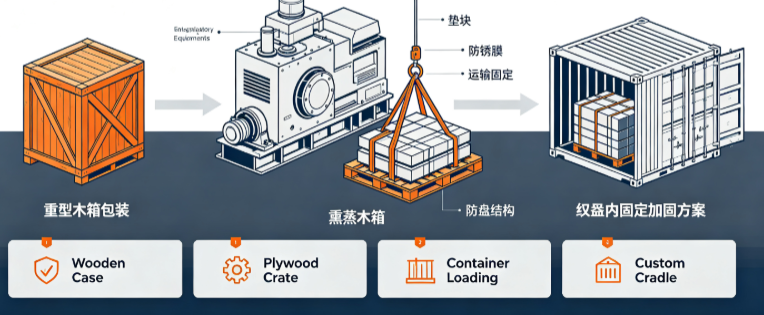
A skid carries the load; a crate or box controls impact, contamination and stacking risk. Heavy equipment may need a reinforced timber skid, plywood panels, solid-wood framing, steel straps or an iron frame combined with an enclosure. The choice depends on weight distribution, handling points, dimensions and route.
Design the base around real support points. Blocking should prevent movement without crushing castings, feet, hoses or covers. Bracing should resist longitudinal, lateral and vertical forces. A high center of gravity may require a wider footprint, additional restraint or a route-specific orientation.
Specify access deliberately. Removable panels, bolted lids, hinged sections or marked lifting zones can reduce unpacking damage. Do not assume a crate can be lifted from any side; provide verified lifting and fork-entry information.
3. Control moisture, shock and handling risk
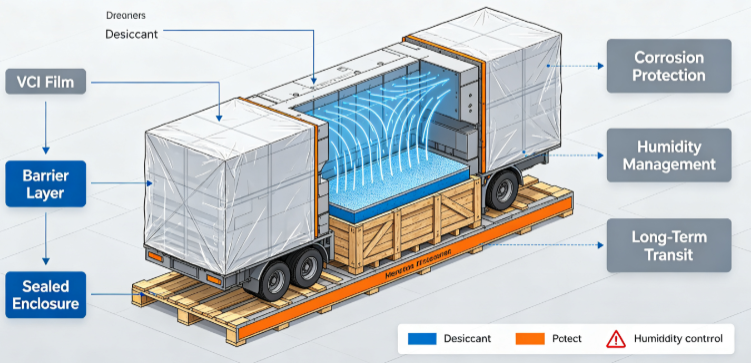
Moisture protection may combine a clean dry interior, barrier film, suitable desiccant planning and controlled sealing. The method depends on the machine, voyage and storage period. Confirm how the barrier is closed, where desiccant is placed and how inspection or resealing can occur.
Shock and vibration control begins with restraint. Use pads, chocks, blocking and bracing matched to contact surfaces. Shock indicators can support awareness but do not replace sound design.
A sealed package moved between warm and cold conditions can trap moisture. Address ventilation, vapor barriers, corrosion protection and unpacking instructions instead of treating “waterproof” as a complete specification.
4. Plan loading, labels and export documents
Check packaged dimensions against the container or vehicle plan. Confirm door clearance, floor loading, lashing points, aisle access and loading sequence. A simple loading drawing can prevent expensive port changes.
Mark gross weight, center of gravity, lifting points, fork pockets, orientation and unpacking warnings where applicable. Use durable labels and include a packing list and photographs when useful.
For solid wood in international trade, ask whether the destination requires ISPM 15 treatment and an accepted mark or evidence. Requirements vary by route and authority; confirm the applicable rule rather than making a blanket claim.
5. Compare suppliers and approve the pack
Evaluate a supplier on technical review, communication, repeatability and documentation, not only price. Ask for a sketch, material assumptions, restraint concept, moisture method, handling marks, inspection points, lead time and delivery scope.
Clarify whether the supplier will visit the site, pack the equipment, load the container or provide only the wooden package. Agree how design changes, damage, nonconformities and urgent replacements will be handled.
OBAO’s public product page shows a broad wood-packaging direction including equipment packaging and several box and pallet formats. Project-specific dimensions, structural calculations, certifications, treatment and capacity should be verified in writing.
Illustrative planning scenario
An industrial pump is prepared for overseas shipment. The team records support feet, center of gravity, exposed coupling and lifting points, then chooses a reinforced skid with blocking, a plywood enclosure and a documented moisture barrier. A loading sketch confirms container fit. This is illustrative, not a reported OBAO case or guaranteed design.
Frequently Asked Questions
What information should I send for a quote?
Send drawings or photos, weight, dimensions, center of gravity, support and lifting points, fragile areas, route, container type, storage duration, finish sensitivity and quantity.
Is a wooden crate always better than a skid?
No. A skid may suit robust equipment with controlled handling, while a closed crate adds protection from impact, contamination and weather. Route and unpacking plan should decide.
How is moisture protection selected?
Consider voyage, storage, sensitivity, temperature changes and corrosion risk. The supplier should specify barrier, sealing, desiccant approach and unpacking instructions.
Do all export crates need ISPM 15?
Rules depend on destination and solid-wood components. Confirm the current route requirement and request applicable evidence.
Conclusion
A reliable solution starts with accurate cargo data and ends with a package that can be handled, loaded, protected and unpacked as planned. Confirm OBAO’s exact construction, materials, treatment and service scope before release.
Ready to Transform Your Packaging?
联系我们获取定制报价,我们的专业团队将为您设计最佳的包装解决方案