How Wooden Pallets Improve Warehouse Efficiency and Product Protection
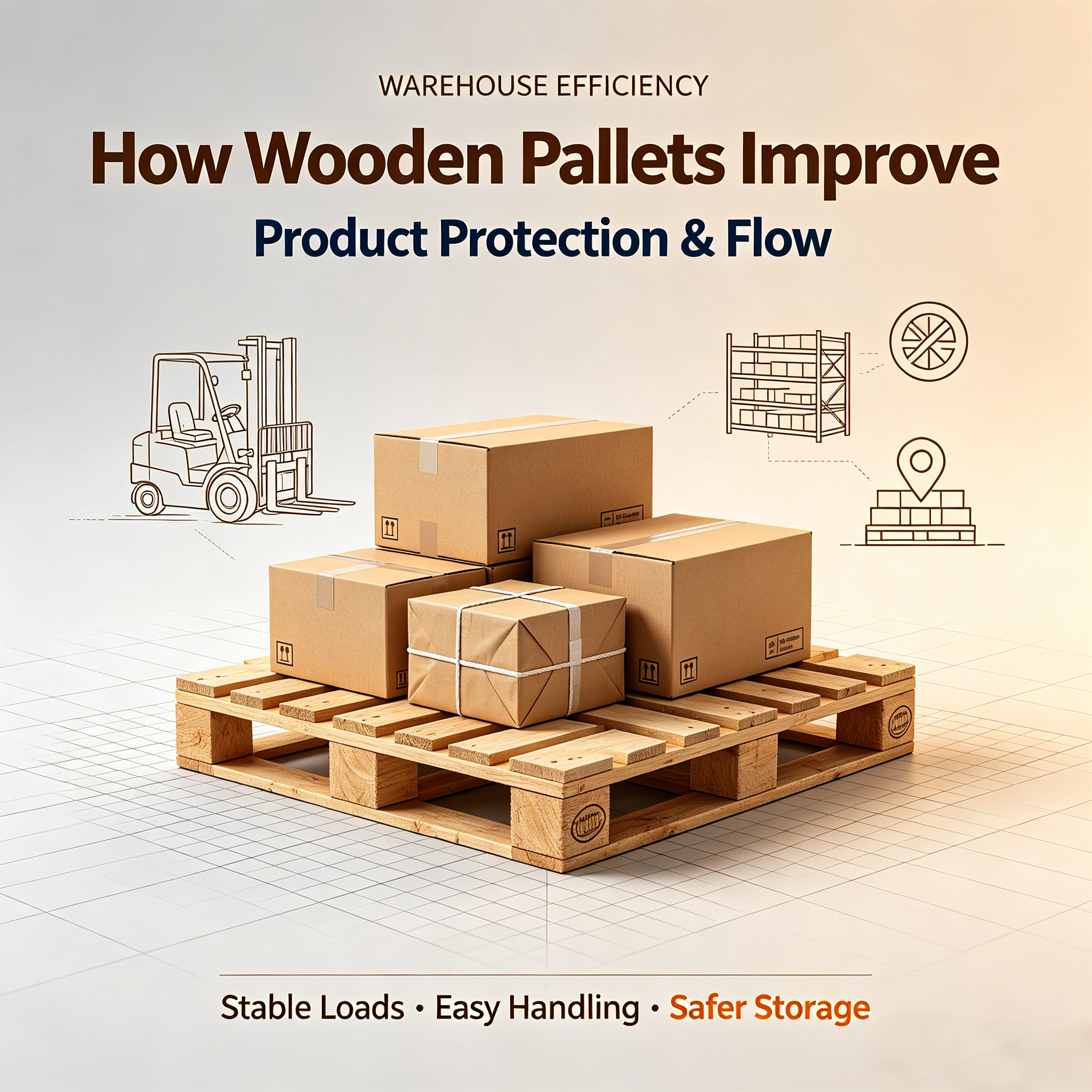
Let me cut straight to the chase. I've been around pallets for two decades—seen them in every type of warehouse, from mom-and-pop operations to massive automated distribution centers. And here's what I can tell you: wooden pallets aren't going anywhere.
Sure, plastic gets the hype. Metal has its niche. But when you dig into the numbers—and I mean the real numbers, not marketing fluff—wood still moves the world. According to Modern Materials Handling’s 2025 Pallet Report, 92% of pallets used by respondents are wood. That's not a trend. That's dominance.
The question isn't whether to use wood. The question is: are you using it right?
Because when you get it right—right species, right design, right handling—wooden pallets don't just carry product. They carry your entire operation's efficiency. And they protect what matters most: your goods, your equipment, and your bottom line.
Let's break down how.
Table of Contents
1. Why Wood Still Wins – The numbers behind the dominance
2. Stringer vs. Block: What's Actually Under Your Load
3. How Wooden Pallets Drive Warehouse Efficiency
4. Product Protection: More Than Just a Platform
5. The Cost Equation Nobody Talks About
6. Compliance, Sustainability, and the 95% Recycling Rate
7. Real-World Case Study: Bespoke Pallets in Automated Warehouses
8. Pallet Selection Cheat Sheet
9. FAQ – What Buyers Actually Ask Me
10. Final Take
Why Wood Still Wins
Let's get one thing straight. I'm not here to sell you on wood because it's nostalgic or cheap. I'm here because the data backs it up.
Global wood pallet market was valued at roughly $14.45 billion in 2025** and is projected to hit nearly **$19 billion by 2031. That's a compound annual growth rate of about 4.6%. Not explosive, but steady. Consistent. The kind of growth you see from a mature, reliable industry that actually works.
And here's a stat that should make you pause: 92% of all pallets in circulation are wood. That number has stayed between 92% and 95% since 2022. So when someone tells you plastic is taking over, ask them for the receipts. The market isn't shifting that way—not yet, anyway.
Stringer vs. Block: What's Actually Under Your Load
This matters more than most people realize. If you're buying pallets without understanding the difference, you're leaving money—and safety—on the table.
Stringer pallets are the workhorses. They use parallel wooden beams (stringers) running the length of the pallet. They're cheaper to manufacture, usually run $10–$15 per unit, and get the job done for most standard applications.
Block pallets use solid wood blocks between the deck boards. They're stronger, offer true four-way entry, and hold up better in automated systems. They cost more upfront—typically $15–$25—but they last longer and handle heavier loads.
Here's the kicker: block pallets can extend service life by 20–30% compared to stringers. Why? Because individual blocks can be replaced without scrapping the whole pallet. That's a real cost saver if you're running high-volume operations.
Quick rule of thumb from the field:
Stringer – Good for one-way shipping, light-to-medium loads, budget-conscious ops
Block – Essential for automated warehouses, heavy loads, and any environment where pallet failure isn't an option
How Wooden Pallets Drive Warehouse Efficiency
Let's talk about what efficiency actually looks like on the warehouse floor. Not theory. Practice.
Standardization is the silent hero. The 48×40-inch pallet is used by 72% of operators. That means your forklifts, racking systems, and conveyor belts are all designed around that footprint. Switch to something else, and suddenly nothing fits. Your equipment works harder. Your throughput drops. Your operators get frustrated.
Four-way entry changes the game. Block pallets allow forklifts and pallet jacks to access from any side. That doesn't sound like much until you've watched a driver waste 30 seconds repositioning for every single pick. Over a shift, that adds up to hours. Over a year, that's real money.
Weight consistency matters more than you think. A standard wooden pallet weighs between 30 and 70 pounds. That variation can be a problem in automated systems where tare weight calculations are critical. But here's the thing: if you're buying from a quality supplier with consistent kiln-dried lumber, you can keep that variance tight. Don't buy the cheapest option and expect consistency. You get what you pay for.
Load capacity isn't one-size-fits-all. Dynamic load—what a pallet can handle while being moved—typically runs 1,500 to 2,500 pounds for standard pallets. Heavy-duty block pallets can push 2,500–3,500 pounds dynamic and 4,000–5,000 pounds static. Know your loads. Overloading a pallet isn't just a safety risk—it's how you destroy inventory and damage equipment.
Product Protection: More Than Just a Platform
I've seen more damaged goods from bad pallets than from bad forklift drivers. And that's saying something.
Nail pops and splinters are the silent killers. A protruding nail doesn't just tear through shrink wrap—it punctures product packaging, contaminates food items, and creates trip hazards. This is why quality control matters. A $0.50 nail** can cause **$500 in damaged goods. Do the math.
Moisture is the enemy. Wood pallets absorb moisture, which leads to warping, mold, and compromised structural integrity. But here's the fix: kiln-dried lumber and heat treatment (more on that in a minute) dramatically reduce moisture content. If you're shipping food, pharmaceuticals, or anything moisture-sensitive, demand kiln-dried pallets. Don't compromise.
Poorly maintained pallets cause 15% of product damage during transport. That's according to the International Pallet Association. Let that sink in. Nearly one-sixth of all transport damage traces back to the platform underneath the product. And the fix? Simple maintenance. Inspect. Repair. Replace when needed.
Industry stats show roughly 25% of wooden pallets need repair or replacement annually. And over 40% of pallet damage happens during forklift operations. That's not a pallet problem—that's an operator training problem. Invest in training. It pays for itself.
The Cost Equation Nobody Talks About
Everyone fixates on upfront cost. Big mistake.
New wooden pallets: $10–$25 per unit. Recycled or repaired: $4–$7 per unit. Plastic pallets: $40–$120 per unit.
On the surface, wood wins. Every time.
But here's where it gets interesting. A high-quality wood pallet lasts about 5–10 trips. A good plastic pallet can do 200+ trips. So the cost per trip for wood might be $1.76**, while plastic could be **$0.26.
So why does wood still dominate?
Because most operations don't run closed-loop systems. Pallets get shipped out and never come back. They're one-way assets. And in that scenario, spending $80 on a plastic pallet that you'll never see again is just throwing money away.
Repair costs are where wood really shines. Repairing a pallet costs $4–$6, compared to $15 for a new one. Professional repair services can restore 60–80% of pallets to serviceable condition at 30–50% of replacement costs. That's not just cost-effective—that's smart asset management.
Quick cost reality check:
l New wood pallet: $10–$25
l Repair: $4–$6 (70% cheaper than replacement)
l Recycled wood pallet: $4–$7
l New plastic: $40–$120
Choose based on your actual operation, not a spreadsheet that doesn't reflect reality.
Compliance, Sustainability, and the 95% Recycling Rate
This is where wooden pallets absolutely crush the competition.
ISPM-15 compliance is non-negotiable for international shipping. Any wood packaging material thicker than 6mm used in cross-border shipments must be treated. That means either heat treatment (HT) —core temperature of 56°C for 30 minutes—or methyl bromide fumigation (MB). Heat-treated pallets are stamped with the IPPC mark, and that stamp is your passport to global trade.
Over 160 countries enforce ISPM-15. Non-compliance means customs delays, fines, or worse—cargo destruction. Don't risk it. Always verify the stamp.
Sustainability isn't marketing fluff—it's measurable. Around 95% of wooden pallets in the U.S. are recycled. They can be repaired and reused up to 15 times before reaching end-of-use. And when they finally wear out, they become mulch, animal bedding, or biofuel. Zero waste. Literally.
Compare that to plastic. Recycling infrastructure for plastic pallets is underdeveloped. Most end up in landfills. The wood pallet industry's recycling rate of 95% is among the highest of any material in any industry.
And here's something most people miss: most of the wood used for pallet manufacturing is leftover lumber from furniture builders and other manufacturers. It's not about cutting down forests—it's about using what would otherwise be waste.
Real-World Case Study: Bespoke Pallets in Automated Warehouses
Let me tell you about Aosom—an online home and garden retailer expanding its UK operations.
Their 3PL partner, MH Star, runs an automated warehouse. And automated warehouses have specific requirements: pallets have to work with robotic lifting systems.
They were buying second-hand pallets that sort of worked. But "sort of" doesn't cut it in automation. They needed something specific: three-legged pallets that matched the robotic lifting profile. And they needed them to be robust—no failures, no jams, no downtime.
They approached multiple suppliers. Most offered standard stock pallets and called it a day. Junction 4 Pallets did something different: they designed and prototyped a custom solution tailored to the automation profile.
The result? Immediate time and cost savings. The bespoke pallet was engineered to meet robotic handling specs while maintaining durability under load. According to Warehouse Manager Jay West: "Without their support and efforts, we would have faced weeks of delays with our automation project".
Here's the takeaway: wooden pallets aren't "dumb" assets. When you work with the right supplier, they become engineered solutions for complex operational challenges. The pallet industry is shifting from commodity supply toward consultative design and service integration. That's a trend worth paying attention to.
Pallet Selection Cheat Sheet
Factor | Stringer Pallet | Block Pallet | What Matters Most |
Upfront Cost | $10–$15 | $15–$25 | Budget and volume |
Four-Way Entry | Sometimes (notched) | Always | Forklift maneuverability |
Load Capacity (Dynamic) | 1,500–2,000 lbs | 2,500–3,500 lbs | Product weight |
Durability | Moderate | High | Trip frequency |
Repair Ease | Moderate | High (replace individual blocks) | Maintenance costs |
Automation Compatibility | Lower | Higher | Warehouse tech level |
Best Use Case | One-way shipping, light loads | Automated ops, heavy loads, pooling | Your actual operation |
FAQ – What Buyers Actually Ask Me
Q: Are wooden pallets safe for food and pharmaceutical shipping?
Yes—if they're heat-treated and kept dry. ISPM-15 heat treatment eliminates pests and reduces moisture. The key is sourcing from suppliers who follow food-grade standards. Avoid pallets with chemical treatments or visible contamination. And always, always inspect before loading.
Q: How long do wooden pallets actually last?
Depends entirely on your operation. In one-way shipping, they last one trip—and that's fine, because that's what they're designed for. In closed-loop systems with proper handling and maintenance, they can last 5–10 years. The National Wooden Pallet and Container Association puts typical lifespan at 5–10 trips before repair or replacement. But good care extends that significantly.
Q: How do I know if a pallet is ISPM-15 compliant?
Look for the stamp. The official ISPM-15 mark includes the IPPC "wheat" logo, a country code, a unique certification number, and a treatment code ("HT" for heat treatment or "MB" for methyl bromide). No stamp? Don't ship it internationally. Period.
Q: Should I buy new or used pallets?
It depends on your use case. New pallets give you consistency, known quality, and full load capacity. Used pallets cost $4–$7 vs. $10–$15 for new—roughly half the price. Used makes sense for one-way shipping or operations where pallets don't come back. New makes sense for pooling, automated systems, and any application where pallet failure isn't an option. Also worth noting: 70% of wood pallets in use are recycled or repaired. Used doesn't mean low quality—it just means you need to inspect what you're buying.
Final Take
Look, I've been doing this long enough to see every trend come and go. Plastic pallets have been "the future" for 30 years. And yet, wooden pallets still move 92% of everything.
Not because people are stuck in their ways. Because wood works.
It's cost-effective. It's repairable. It's sustainable—with a 95% recycling rate that no other material can touch. It's compatible with global shipping standards through ISPM-15. And when you choose the right design—stringer or block, new or used, standard or bespoke—it delivers real efficiency gains and genuine product protection.
The key is treating pallets as what they are: critical infrastructure, not disposable accessories. Invest in quality. Train your operators. Inspect regularly. Repair instead of replace when you can. And partner with suppliers who understand your operation, not just their inventory.
Because at the end of the day, a pallet isn't just wood and nails. It's the platform your entire supply chain sits on.
Ready to Transform Your Packaging?
联系我们获取定制报价,我们的专业团队将为您设计最佳的包装解决方案